Caldwell is consistently ranked as a "Best College" by the U.S. News & World Report.
Explore Degrees95% of grads are employed, in grad school, or committed to service within 6 months of graduation
Apply Today!The “Caldwell Commitment” program provides aid to students entering Caldwell University based on academic merit and financial needs.
Learn more14 NCAA Division II Athletics Programs
View AthleticsLocated just 22 miles from NYC and one hour from the Jersey Shore, Caldwell was rated as the "Best College Town in NJ."
Discover Caldwell
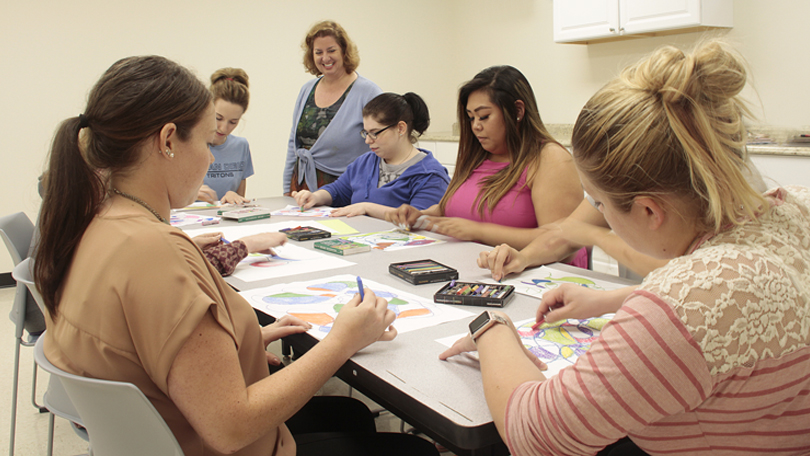
For students interested in a later career in art therapy, the department offers a double major in art and psychology with an art therapy concentration in conjunction with the Department of Art. With the exception of art education majors, all B.A. students must complete at least one upper-level course in the area of study chosen for their senior thesis exhibit. For example, Both Painting I and Painting II are required for students presenting painted works for their senior thesis exhibit.
Note that the Double Major in Art and Psychology with Art Therapy Concentration is designed to provide a strong preparatory base for graduate study in art therapy and meets the educational requirements for entry into Caldwell’s graduate program in Clinical Mental Health Counseling with an art therapy concentration. Registration and practice as an art therapist requires master’s level preparation. Qualified undergraduates in the double major with Art Therapy Concentration may also take advantage of the opportunity to pursue their M.A. in Clinical Mental Health Counseling with an art therapy concentration in an accelerated manner through the Combined B.A./M.A. program.
JUNIOR COMPREHENSIVE 1 credit
In the junior year students are required to execute independently a series of works that demonstrate proficiency in various media. All art faculty evaluate students in a group critique. An evaluation of each individual student is made jointly by the department. Areas of weakness are addressed and students may be required to repeat a project. Students may be required to do additional coursework if skill or understanding in a particular area(s) is insufficient. Junior Project students may not go on to enroll in the Senior Thesis Exhibit until all studies for the Junior Project and any remedial coursework are satisfactorily completed. Students should have taken the following courses prior to their junior year: AR 111 Drawing I, AR 200 2D Design and Color Theory, AR 118 3D Design and AR 280 Painting I.
It is strongly recommended that students take this course in the fall semester
SENIOR SEMINAR 2 credits
In the fall semester of senior year all seniors are required to enroll in the Senior Seminar. Students are required to research a contemporary artist of their choice who makes work that relates to the student’s area of interest. Students must also write a detailed proposal for their senior thesis exhibition which takes place in the spring semester of their senior year. A grade of C is required to pass. Course may be retaken the following fall if not passed. This course may not be taken if a student has failed the Junior Comprehensive.
B.A. SENIOR EXHIBIT 2 credits
In the spring semester a group exhibition is scheduled for three to four students at one time. Each student is designated a gallery area in which to mount a selection of works specifically and independently developed for this exhibit. B.A. students must complete at least one upper-level course in the area of study chosen for their Senior Thesis Exhibit. For example: Both Painting I and Painting II are required for students presenting painted works for their Senior Thesis Exhibit. The full-time faculty meets with the students to critique the installation and the work of each individual. The session follows the procedures outlined for the B.F.A. critique session.
The B.A. exhibit may not be taken if a student has not received a grade of C or above in the senior seminar or minor program
For outcomes assessment in Psychology please visit the Department webpage
Course Code : AH 212
Course Group(s) : Art History, Fine Arts Requirement
Course Description :
An introduction to artistic traditions before 1400. Includes the art of Egypt, Greece, Rome, India, China and Europe.
Credit : 3
Course Code : AH 214
Course Group(s) : Art History, Fine Arts Requirement
Course Description :
Investigates the historical and theoretical premises of modernism. Surveys the visual arts from the late nineteenth century through the 1960s. Includes stylistic movements such as Cubism, Expressionism, and Surrealism.
Credit : 3
Course Code : AH 215
Course Group(s) : Art History, Fine Arts Requirement
Course Description :
An introduction to artistic traditions from 1400 to 1800. Topics include European Renaissance and Baroque, and the artistic conventions of Africans, Native Americans, and Islamic peoples.
Credit : 3
Course Code : AR 111
Course Group(s) : Fine Arts Requirement
Course Description :
A foundation class designed to develop the student’s ability to “see” and understand the elements of drawing and composition. Line, form, space, scale and value will be explored through a series of exercises and projects.
Credit : 3
Course Code : AR 118
Course Group(s) : Fine Arts Requirement
Course Description :
A foundation studio class that explores the language of three-dimensional form and design principles. Students are introduced to a variety of materials including wire, clay, cardboard, and plaster. Studio work, outside assignments, lectures, slides, and demonstrations.
Credit : 3
Course Code : AR 200
Course Group(s) : Fine Arts Requirement
Course Description :
AR200 is 3 credits, 2D Design and Color is an introduction to the visual arts. Students are introduced to the process of visual element selection for the purpose of expressing themselves. Emphasis on the orchestration and analysis of point, line, shape, value, texture and color will enhance visual perception, and an understanding of the concepts, vocabulary, and skills for building 2D visual literacy. Color analysis, aesthetic investigation, techniques, materials, and composition are explored through hands-on projects which will complement and reinforce learned 2D principles.
Credit : 3
Course Code : AR 220
Course Description :
Introduces computers in the making of visual art. Students work with a variety of peripherals and software and learn to appreciate the special creative possibilities they afford.
Credit : 3
Course Code : AR 227
Course Description :
Studies the fundamentals of the human form through studio classes working directly from the human figure.
Credit : 3
Course Code : AR 250
Course Description :
Focuses on the making of sculptural objects through the investigation of historic and contemporary trends and by developing personal and perceptual considerations, technical skill, and the development of an individual working process. Required museum and gallery trips.
Credit : 3
Course Code : AR 280
Course Group(s) : Fine Arts Requirement
Course Description :
Studies the elements of painting, color, form and composition through a systematic series of exercises using still life, nature, and model. Includes studio work, outside assignments, lectures, slides, and demonstrations.
Credit : 3
Course Code : AR 310
Course Description :
Students are expected to participate in a group exhibition in their junior year. They must have completed all introductory art requirements (or approved equivalents) before taking this course. The work will include independent work in drawing, painting, 2D and 3D design as well as class projects. A satisfactory grade must be received before taking Senior Seminar.
Credit : 1
Course Code : AR 455
Course Description :
Guides the development of individual research as it relates to students work. Required by all art majors, it includes proposal writing, development of concepts/techniques and a research paper.
Credit : 2
Prerequisites :
AR310
Course Code : AR 465
Course Description :
For B.A. students; requires the student to participate in a final group exhibition in the second semester of senior year.
Credit : 2
Instruction methods : Lecture: 2 Hours
Prerequisites :
AR455
Course Code : AT 230
Course Group(s) : Fine Arts Requirement
Course Description :
This course offers an introduction to the art therapy profession. Students will learn about the interface of art and therapy, as well as basic theory and application. Students will participate in experiential art exercises which will provide exposure to the use of the creative process of communicating through art.
Credit : 3
Course Code : AT 310
Course Description :
This course offers students the opportunity to learn about various art materials and techniques of practice applicable to the needs of a varying client population. Through direct experience, students focus on the relationship of art making to art therapy.
Credit : 3
Prerequisites :
AT230
Course Code : AT 320
Course Group(s) : Psychology 300 Level Courses
Course Description :
Students study specific applications of art therapy as they relate to clinical populations from children to adults. Art-based assessment and art therapy methods with individuals and groups are examined.
Credit : 3
Prerequisites :
AT230
One additional studio course 300-level or above in chosen area of study
Required Psychology Courses
Course Code : PS 101
Course Description :
This course provides a survey of the major areas of psychology, the scientific study of behavior and mental processes. Major content areas include research methodology, biopsychology, learning, psychopathology, and cognitive, social, and developmental psychology
Credit : 3
Course Code : PS 208
Course Group(s) : Psychology 200 Level Courses
Course Description :
Introduces descriptive and inferential statistical methods to summarize, organize, and interpret data. Topics include data organization, measures of central tendency, variability, z-scores, logic of hypothesis testing, t-tests, ANOVA, and correlation.
Credit : 3
Prerequisites :
MA220, MA130, MA117, MA116, MA208, MA131, MA207, MA222, MA221, MA106, MA108, MA 105, MA 112
Course Code : PS 213
Course Group(s) : Psychology 200 Level Courses
Course Description :
This course serves as an introduction to scientific writing and the style conventions set by the American Psychological Association (APA). Students will practice information literacy and enhance their understanding of the writing process as it applies to psychology. Topics will include APA style conventions, components of the scientific paper, information gathering, plagiarism, and the writing process.
Credit : 3
Course Code : PS 402
Course Description :
Focuses on research methods and design as applied to contemporary problems in psychology. The course involves independent research projects.
Credit : 3
Prerequisites :
BU305, PS208
Course Code : PS 425
Course Description :
Discusses historical and contemporary issues in psychology. Course involves seminar presentations on selected topics.
*Curricular changes will go into effect the following academic year, unless otherwise noted.
Credit : 3
Prerequisites :
PS 101
Select 2 courses from Psychology Cluster 1 (6 credits)
Course Code : PS 304
Course Group(s) : Psychology 300 Level Courses, Psychology Cluster 1
Course Description :
An overview of the physiological processes relating to human behavior. Topics include the central nervous system, neurotransmitter and neurohormonal functioning, the biological basis for emotions, perception, motivation and brain disorders.
Credit : 3
Prerequisites :
PS 101
Course Code : PS 323
Course Group(s) : Psychology 300 Level Courses, Psychology Cluster 1
Course Description :
Examines the processes underlying how we experience (sense) and interpret (perceive) the world around us. Emphasis will be placed on the function and structure of the various sensory systems and their corresponding processing centers in the brain.
*Curricular changes will go into effect the following academic year, unless otherwise noted.
Credit : 3
Prerequisites :
PS 101
Course Code : PS 326
Course Group(s) : Psychology 300 Level Courses, Psychology Cluster 1
Course Description :
Examines the cognitive processes broadly referred to as thinking. Emphasis will be placed on a discussion of memory models, consciousness, attention, language, concept learning, reasoning, problem-solving, and neural networks. Classical theories and experiments in these areas will be reviewed.
*Curricular changes will go into effect the following academic year, unless otherwise noted.
Credit : 3
Prerequisites :
PS 101
Course Code : PS 328
Course Group(s) : Psychology 300 Level Courses, Psychology Cluster 1
Course Description :
This course focuses on major learning perspectives including classical conditioning, operant conditioning, and social learning theory.
Credit : 3
Select 1 course from Psychology Cluster 2 (3 credits)
Select 1 course from Psychology Cluster 3 (3 credits)
Select 1 course from Psychology Cluster 4 (3 credits)
Course Code : PS 309
Course Group(s) : Psychology 300 Level Courses, Psychology Cluster 4
Course Description :
Examines the symptoms, causes, diagnosis and treatment of psychological disorders.
Credit : 3
Prerequisites :
PS204, PS150, PS207.
Course Code : PS 210
Course Group(s) : Psychology 200 Level Courses, Psychology Cluster 4
Course Description :
Explores patterns and possible causes of emotional and behavioral problems in children. The course also examines treatment methods used with children and effective parenting styles.
Credit : 3
Students may apply in the semester prior to the semester during which they intend to begin the combined degree program.
• Completion of at least 60 undergraduate credits with a minimum 3.3 overall GPA (this minimum must be maintained also for the remainder of the undergraduate coursework).
• Completion of PS 150/207 General Psychology, PS 208 Psychological Statistics, PS 232 Psychology of Personality and either PS 309 Psychopathology OR a course in human development (PS 211, PS 216) as well as AR 111 Drawing, AR 113 2D Design, and AR 118 3D Design (or their equivalent if the student has transferred to Caldwell University) and AT 230 Intro to Art Therapy.
• Two letters of recommendation from undergraduate faculty in psychology and/or art (forms provided).
• Submission of an APA style paper.
• Art portfolio (10-15 pieces) demonstrating competency in drawing, painting and sculpture.
• Personal or group interview with program coordinator.
• Completion graduate application form.
• M.A. in Counseling requirement of the GRE/MAT will be waived for students who matriculate through the combined degree program.
Curriculum Substitutions
Once accepted into the M.A. program a student may fulfill undergraduate program requirements or electives with graduate courses
Students may fulfill undergraduate program requirements or electives with graduate courses according to the tables below:
UNDERGRADUATE COURSE GRADUATE SUBSTITUTE
PS 310 Career Counseling CPS 633 Career Counseling
AT 310 Art Therapy Methods CAT 507 Art Therapy Methods in Counseling
AT 320 Art Therapy in Practice CAT 501 History & Development in Art Therapy
AND One CAT Elective with Advisement
Community Mental Health and Wellness Services
The Mary Jo Rolli Codey Center
The Mary Jo Rolli Codey Center is located on the Caldwell University campus. The Center is a training facility partnered with the Clinical Mental Health Counseling with Art Therapy concentration graduate education program, providing confidential, quality services. Members of the local community can access treatment for personal growth or for mental health conditions in group and individual formats. Services to the local community are provided by credentialed mental health counselors with art therapy training and advanced master’s students under the supervision of program faculty.
Caldwell University is proudly powered by WordPress