

Caldwell University
June 30, 2026
Bridging Faith and Technology: Caldwell University’s President Meets Pope Leo in Rome
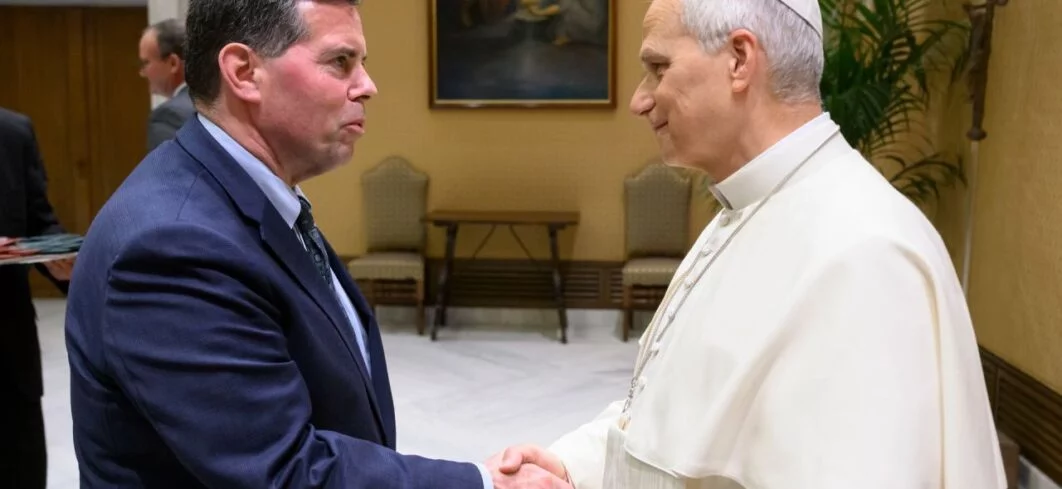
Rome, Italy – Caldwell University president, Dr. Jeffrey Senese, had the opportunity to travel to Rome with a group of 18 fellow Catholic university presidents through the Association of Catholic Colleges and Universities (ACCU). The seminar offered a rare look at the inner workings of the Roman Curia and opportunities to discuss the future and importance of catholic education.
For Dr. Senese and the other presidents, the highlight of the seminar was a private audience with the Holy Father, Pope Leo XIV. Dr. Senese recalls the Holy Father’s statement to the group, saying “Pope Leo’s statement calls Catholic universities to resist intellectual and spiritual fragmentation, to integrate faith and reason, and to foster in students a lifelong pursuit of truth rooted in Christ.”
During his private audience, Dr. Senese assured the pope that the Caldwell community is praying for him and asked the Holy Father what we should be doing. His answer was simple; focus on the students, help them to be all they can be, faithful and successful. He also highlighted the importance of being in and of the community to make a positive difference.
The personal encounter underscored a broader shift in Vatican leadership. In discussions with several correspondents based in Rome who cover the Vatican and the Curia; Elise Ann Allen, Gerard O’Connell, and Elisabetta Pique highlighted these differences. Their view is that Pope Leo moves more slowly than Pope Francis and is more reflective. Pope Leo is focused on Vatican finances, the abuse crisis, global polarization, and synodality in the church.
Artificial intelligence (AI) is also a major issue in Pope Leo’s eyes, a theme that was pervasive throughout the seminar.
Throughout the week, Vatican officials repeatedly tied technology directly to human rights and educational equity. Archbishop Carlo Maria Polvani, Secretary of the Dicastery for Culture and Education, discussed AI and that education is a human right and, therefore, connected to our mission. Later, Bishop Paul Tighe expanded on this theme, referencing the encyclical Magnifica Humanitas. Tighe warned that the speed of the machine should not drive the development of AI but it should be driven by people.
The conversation culminated with a lecture from Sister Helen Alford, OP, President of the Pontifical Academy of Social Sciences, who cautioned against over-relying on machines at the expense of human capacity. True human perfection isn’t the goal, Alford argued; instead, AI should be used inclusively and that Humanitas is an invitation to promote conversation.
The weeklong seminar was full of incredible opportunities; attending Mass at the Chapel of St. Monica in the Vatican, where Pope Leo XIV received his priestly ordination, visiting the Basilica of Saint Mary Major where Pope Francis is buried, and getting to hear from many Vatican officials.
“In the end, this was an amazing experience for the 19 presidents who had the honor to attend,” said Dr. Senese. “Both for us personally and for our institutions.”